
These trends highlight a critical gap. Insurers are not lacking data, but they are lacking the ability to activate it in real time.
Traditional Customer 360 systems attempted to solve this problem by unifying data. However, unification without intelligence does not deliver business outcomes. A new approach is required, one that combines AI-native architecture, machine learning, and Digital Twin Intelligence to transform how insurers operate.
Why Traditional Customer 360 Falls Short in General Insurance
Traditional Customer 360 implementations often fail to deliver impact because they are built on outdated assumptions about how data should be processed and used.
-
Static Customer Profiles Limit Decision-Making
Most systems rely on batch updates and historical data, which results in outdated customer views. This limits the ability to act in real time and reduces the relevance of engagement.
Common limitations include:
- Customer profiles updated periodically instead of continuously
- Decisions based on past behavior rather than future intent
- Inability to respond instantly to customer actions
-
Fragmented Intelligence Across Functions
Even when data is consolidated, intelligence remains siloed across departments. This creates inconsistency in decision-making and customer experience.
- Marketing operates on campaign-level insights
- Claims teams lack full interaction context
- Underwriting relies on incomplete risk signals
- Customer service lacks a unified view of history
This fragmentation leads to inefficiencies and missed opportunities across the value chain.
-
AI as an Add-On Instead of a Core Capability
Many legacy systems introduce AI as a secondary layer, which limits its effectiveness.
- AI models operate in isolation
- Insights require manual interpretation
- Limited scalability across use cases
As a result, insurers struggle to fully leverage predictive capabilities.
-
Reactive Rather Than Predictive Operations
Traditional systems focus on reporting past events rather than predicting future outcomes. This makes it difficult to:
- Identify churn risks early
- Recommend the right products
- Optimize engagement timing
-
Lack of Continuous Learning
Customer behavior evolves constantly, but most systems do not adapt.
- No feedback loop from campaigns
- Limited learning from customer interactions
- Declining accuracy of insights over time
What AI-Native Customer 360 Means in Insurance
AI-native Customer 360 represents a shift fromh
-
Key Capabilities of AI-Native Architecture
AI-native platforms differ from traditional systems in several important ways:
- Intelligence embedded across the system
AI is integrated into data processing, identity resolution, segmentation, and activation - Real-time data processing
Streaming data replaces batch updates, enabling instant decision-making - Unified intelligence layer
All teams operate on the same real-time customer view - Predictive and prescriptive capabilities
Systems not only predict outcomes but also recommend actions - Continuous learning loops
Every interaction improves future predictions
This approach transforms Customer 360 into a dynamic intelligence engine that drives business outcomes.
- Intelligence embedded across the system
The Role of 15+ ML Models Working Together
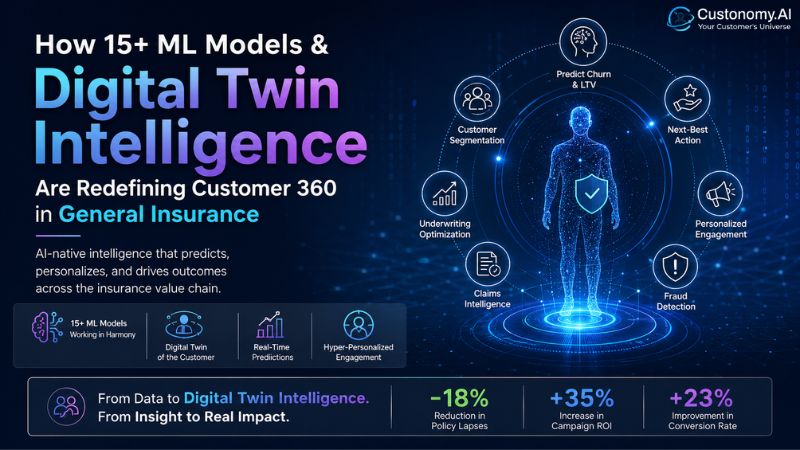
Custonomy’s architecture is built on a multi-model approach, where more than 15 machine learning models work together to create a unified intelligence system.

-
Why Multi-Model Intelligence Matters
Customer behavior is influenced by multiple factors, including:
- Policy history
- Claims behavior
- Digital interactions
- Lifecycle stage
- External signals
A single model cannot capture this complexity effectively. Multiple models working together provide a more accurate and holistic understanding.
-
Key ML Capabilities
Custonomy leverages different models to solve specific business problems:
- Churn prediction models
Identify customers likely to lapse and enable proactive retention - Customer lifetime value models
Prioritize high-value customers for targeted engagement - Propensity and affinity models
Predict product preferences and buying intent - Next-best-action models
Recommend optimal engagement strategies - Fraud detection models
Identify anomalies across claims and behavior - Dynamic segmentation models
Enable real-time grouping based on behavior and context
- Churn prediction models
-
From Individual Models to an Intelligence Ecosystem
The real power lies in orchestration.
- Models continuously share insights
- Predictions are refined in real time
- Decisions are based on combined intelligence
This creates a system where intelligence is not fragmented but unified across the organization.
Digital Twin of the Customer: A New Paradigm
The Digital Twin of the Customer represents a significant advancement in Customer 360.
-
What is a Digital Twin
A Digital Twin is a dynamic and continuously evolving representation of a customer that combines data from multiple sources into a single intelligence layer
This includes:
- Policy data
- Claims history
- Interaction data
- Behavioral signals
- Digital activity
- Third-party data
-
What Makes Digital Twin Intelligence Powerful
Digital Twin Intelligence enables insurers to:
- Track customer state in real time
- Simulate customer journeys before execution
- Deliver context-aware personalization
- Continuously refine predictions

Explore how Custonomy can help you build a real-time, AI-powered intelligence foundation for general insurance.
How It Transforms Customer Understanding
Traditional profiles are static snapshots. Digital Twins are dynamic systems.
- Profiles show what happened
- Digital Twins predict what will happen next
This shift enables insurers to move from reactive engagement to proactive strategy.
Real-Time Predictions That Transform Insurance Operations
AI-native architecture combined with ML models enables real-time predictive intelligence across key areas:
-
Key Predictive Capabilities
- Churn prediction
Identify at-risk customers and trigger timely interventions - Customer lifetime value prediction
Optimize resource allocation and engagement strategies - Next-best-action recommendations
Guide interactions with precision - Fraud detection
Identify suspicious patterns early - Engagement prediction
Improve campaign effectiveness and conversion rates
- Churn prediction
Business Impact Across the Insurance Value Chain
The shift to an AI-native Customer 360 is not just a technology upgrade. It fundamentally changes how every function within an insurance organization operates. When intelligence becomes real time, unified, and predictive, it enables teams to move from reactive execution to proactive decision-making.
This transformation creates measurable impact across the entire insurance value chain.
-
Retention and Growth
Customer retention is one of the most critical levers for profitability in insurance. However, traditional approaches rely heavily on reactive engagement, often reaching out to customers only when renewal is imminent or after signs of disengagement are already visible.
AI-native Customer 360 changes this dynamic by enabling early detection of churn signals and proactive intervention.
- Identify policyholders at risk of lapse using behavioral, engagement, and policy signals
- Trigger personalized renewal journeys tailored to customer preferences and lifecycle stage
- Prioritize high-value customers using predictive lifetime value models
- Deliver timely nudges through the most effective channels
This approach allows insurers to engage customers before dissatisfaction escalates. Even small improvements in retention can significantly impact profitability, as retaining an existing customer is far more cost-effective than acquiring a new one.
-
Sales and Cross-Sell
Insurance growth increasingly depends on the ability to deepen relationships with existing customers rather than relying solely on new acquisitions. However, without clear visibility into customer needs and intent, cross-sell and upsell efforts often remain generic and ineffective.
With AI-driven intelligence, insurers can shift toward precision selling.
- Recommend products based on real-time behavior, policy history, and life events
- Identify high-propensity customers who are more likely to convert
- Prioritize leads using predictive scoring models
- Equip agents with complete customer context before every interaction
This enables sales teams and agents to move from reactive conversations to insight-led engagement. As a result, interactions become more relevant, conversion rates improve, and overall customer lifetime value increases.
-
Underwriting
Underwriting is a data-intensive function that relies on accurate risk assessment and pricing decisions. Traditional underwriting processes often depend on limited or outdated data, which can lead to suboptimal pricing and increased exposure to risk.
AI-native Customer 360 enhances underwriting by providing a more comprehensive and dynamic view of the customer.
- Enrich risk profiles using behavioral, demographic, financial, and third-party data
- Identify emerging risk patterns through continuous data analysis
- Improve pricing accuracy by incorporating real-time signals
- Enable faster underwriting decisions with pre-filled, data-driven insights
This leads to more precise risk evaluation and better alignment between pricing and actual risk exposure. It also reduces manual effort and accelerates decision-making processes.
-
Claims
Claims processing is one of the most critical touchpoints in the customer journey. It directly impacts customer satisfaction and trust. However, claims teams often operate with incomplete information, which leads to delays and repetitive processes.
AI-native Customer 360 transforms claims handling by providing full context and intelligent automation.
- Give claims teams access to complete customer history, including policies, interactions, and documents
- Route claims based on urgency, value, and risk profile
- Reduce the need for customers to repeat information across touchpoints
- Automate workflows to improve efficiency and reduce processing time
This results in faster claim resolution, improved operational efficiency, and a more seamless customer experience during moments that matter most.
-
Marketing Efficiency
Marketing in insurance has traditionally relied on broad segmentation and generic campaigns. This often leads to wasted spend and low engagement.
With AI-native Customer 360, marketing becomes highly targeted and data-driven.
- Build precise audience segments using real-time behavioral and policy data
- Deliver personalized campaigns across digital and offline channels
- Optimize timing, messaging, and channel selection using predictive insights
- Continuously refine campaigns based on performance data
This level of precision significantly improves campaign effectiveness while reducing unnecessary spend. It ensures that marketing efforts are focused on customers who are most likely to engage and convert.
-
Fraud Prevention
Fraud remains a significant challenge for insurers, with evolving patterns making it increasingly difficult to detect using traditional rule-based systems. Fraud often goes unnoticed when data is fragmented across systems.
AI-native Customer 360 enables a more proactive and comprehensive approach to fraud detection.
- Analyze multi-channel data, including claims, behavior, and interactions
- Identify anomalies and suspicious patterns in real time
- Strengthen risk assessment with enriched customer context
- Reduce false positives by using advanced machine learning models
This improves the accuracy of fraud detection while reducing financial losses and operational risk. It also enhances compliance by ensuring better visibility and traceability of data.
-
From Customer Data to Customer Intelligence
The insurance industry is moving toward a model where competitive advantage is defined by the ability to act on data in real time. Data alone does not create value. Value is created when data is transformed into intelligence that can drive decisions.
To achieve this, insurers need a strong foundation built on four key pillars.
What This Transformation Requires
- Unified data
All customer data from policies, claims, interactions, and digital channels must be consolidated into a single, reliable view - AI-native processing
Intelligence must be embedded into the system, enabling real-time analysis and decision-making - Continuous learning
Systems must evolve with every interaction, improving accuracy and relevance over time - Predictive intelligence
Insights must move beyond reporting to predicting future behavior and recommending actions
How Custonomy Enables This Shift
Custonomy bridges the gap between data and intelligence by combining advanced machine learning models with Digital Twin technology.
It enables insurers to:
- Unify fragmented data across all touchpoints into a single customer view
- Apply 15+ machine learning models to generate real-time insights
- Create a Digital Twin of each customer that evolves continuously
- Activate intelligence across marketing, sales, underwriting, claims, and service
Instead of relying on static reports, insurers gain access to a dynamic intelligence system that supports decision-making at every stage of the customer lifecycle.
From Storage to Intelligence Activation
Traditional systems focus on storing and organizing data. Modern platforms like Custonomy focus on activating intelligence.
- Data becomes actionable
- Insights become predictive
- Decisions become proactive
This shift allows insurers to move beyond operational efficiency and unlock new opportunities for growth, personalization, and customer engagement.
Conclusion: The Future of Insurance Belongs to Intelligent Systems
The general insurance industry is at a point where incremental improvements are no longer enough. Customer expectations are rising, competition is intensifying, and the pace of change continues to accelerate. In this environment, relying on fragmented data and static customer views limits both growth and innovation.
Customer 360 must evolve from a reporting layer into a real-time intelligence system that can understand, predict, and act. This is where AI-native architecture, multi-model machine learning, and Digital Twin Intelligence come together to redefine what is possible.
Insurers that embrace this shift gain the ability to:
- Anticipate customer needs instead of reacting to them
- Personalize every interaction based on real-time context
- Improve retention, conversion, and customer lifetime value
- Strengthen underwriting, claims, and fraud detection with deeper insights
- Align all functions around a single, continuously evolving customer view
This is not just a technology upgrade. It is a transformation in how decisions are made across the organization.
Custonomy enables this transformation by turning fragmented data into a living intelligence system. With 15+ machine learning models working together and a Digital Twin of every customer, insurers can move from static profiles to dynamic, predictive intelligence that drives measurable business outcomes.
The competitive advantage in insurance will no longer come from having more data. It will come from the ability to activate that data in real time and translate it into smarter decisions.
Organizations that adopt this approach will be better positioned to lead in a market defined by personalization, speed, and intelligence. Those that continue to rely on traditional systems risk falling behind.
Unlock the Full Potential of Your Customer Data
Turn fragmented policyholder data into real-time, AI-driven intelligence that powers growth, retention, and smarter decisions.