
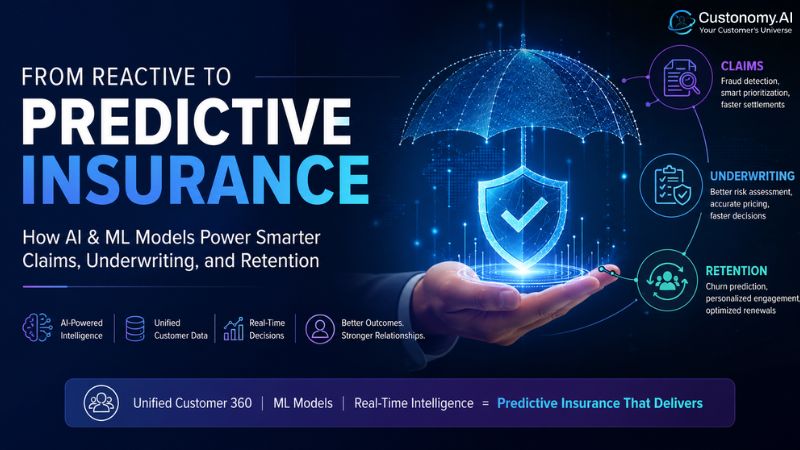
The shift toward predictive capabilities is already underway. A report by Deloitte indicates that insurers leveraging artificial intelligence in underwriting and claims processing are seeing faster decision cycles and improved accuracy. At the same time, studies show that predictive models can increase customer retention by identifying churn risks early and enabling timely intervention.
Insurance is moving from rule-based operations to intelligence-driven ecosystems where decisions are powered by artificial intelligence, machine learning, and unified customer data. Instead of reacting to events after they occur, insurers can now predict outcomes, optimize decisions, and personalize engagement at scale.
This transformation is not limited to a single function. It is reshaping the entire insurance value chain.
- Claims processing is becoming faster and more accurate through predictive fraud detection and intelligent routing
- Underwriting is evolving with real-time risk assessment and data-driven pricing
- Customer retention is improving through proactive engagement and personalized renewal strategies
At the core of this transformation lies a critical foundation. Artificial intelligence models can only deliver value when they are powered by unified, real-time customer intelligence. Without this foundation, even the most advanced models fail to produce consistent and actionable insights.
Custonomy addresses this challenge by combining AI-native architecture, machine learning models, and Customer 360 intelligence to enable predictive decision-making across claims, underwriting, and retention.
This blog explores how insurers can move from reactive operations to predictive intelligence and how AI and machine learning models are driving measurable impact across the most critical functions of the insurance business.
The Shift from Rule-Based to AI-Driven Insurance
The traditional insurance operating model has been built on rules, thresholds, and historical benchmarks. Underwriting decisions have relied on predefined criteria, claims processing has followed standardized workflows, and customer engagement has been triggered by fixed timelines such as renewal reminders. While this approach ensured consistency, it limited the ability to adapt to changing customer behavior and emerging risks.
This limitation is becoming increasingly visible as the insurance landscape evolves. Customers interact across multiple channels, risk patterns are more dynamic, and fraud techniques are continuously changing. Static rules are not designed to handle this level of complexity.
Industry research reinforces this shift.
According to PwC, insurers that adopt advanced analytics and artificial intelligence can significantly improve underwriting accuracy and operational efficiency, while also enhancing customer experience. Similarly, insights from Capgemini highlight that data-driven insurers are outperforming peers in both growth and customer satisfaction.
The move from rule-based systems to AI-driven decisioning introduces several fundamental changes in how insurers operate.
-
From Static Rules to Dynamic Intelligence
Traditional systems depend on fixed rules that do not adapt easily to new data. AI-driven systems continuously learn and adjust based on real-time inputs.
- Rules are replaced by models that evolve with customer behavior
- Decisions are based on probabilities rather than fixed thresholds
- Insights improve over time through continuous learning
-
From Historical Analysis to Predictive Decision-Making
Legacy systems primarily focus on analyzing past events. AI enables insurers to anticipate future outcomes and act accordingly.
- Predict which customers are likely to churn
- Forecast claim outcomes and potential fraud
- Estimate lifetime value and future engagement
-
From Siloed Functions to Unified Intelligence
In traditional environments, each function operates independently with limited data sharing. AI-driven ecosystems unify intelligence across departments.
- Claims, underwriting, and marketing operate on the same data foundation
- Decisions are consistent across touchpoints
- Customer experience becomes seamless and personalized
-
From Manual Processes to Intelligent Automation
Manual intervention has historically been a key part of insurance operations. AI introduces automation that is guided by intelligence rather than rigid workflows.
- Claims are routed automatically based on risk and priority
- Underwriting decisions are accelerated with data-driven insights
- Customer engagement is triggered based on real-time behavior
-
From Reactive Engagement to Proactive Strategy
Perhaps the most significant shift is the move from reacting to events to anticipating them.
- Engage customers before they consider switching
- Detect fraud before claims are processed
- Adjust pricing and risk strategies dynamically

Start Your Predictive Insurance Journey
Discover how AI and unified customer intelligence can transform your claims, underwriting, and retention strategies.
How ML Models Are Transforming Core Insurance Functions
The shift to AI-driven insurance becomes tangible when machine learning models are applied to the functions that define performance and customer experience. Claims, underwriting, and retention sit at the center of this transformation. These areas directly influence profitability, risk exposure, and long-term customer relationships.
Machine learning enables insurers to move beyond static rules and manual judgment by uncovering patterns in large volumes of data and translating them into actionable insights. The impact is not theoretical. It is measurable across operational efficiency, accuracy, and customer outcomes.
-
AI in Claims: From Processing to Intelligent Resolution
Claims processing has traditionally been one of the most resource-intensive and time-sensitive functions in insurance. It is also a critical moment of truth for customers. Delays, repeated information requests, and lack of transparency often lead to dissatisfaction.
Machine learning is transforming claims from a reactive process into an intelligent and predictive function.
-
Key Applications of ML in Claims
- Fraud detection
Machine learning models analyze behavioral patterns, claim histories, and cross-channel signals to identify anomalies that may indicate fraud.
According to Coalition Against Insurance Fraud, insurance fraud costs the industry tens of billions of dollars annually, making early detection critical. - Claims prioritization and routing
Models assess claim severity, customer value, and risk factors to prioritize cases and route them to the appropriate teams. - Outcome prediction
Predictive models estimate claim settlement timelines, costs, and potential disputes, enabling better planning and faster resolution. - Automation of low-risk claims
Straight-through processing becomes possible for simple claims, reducing manual effort and improving turnaround time.
- Fraud detection
-
AI in Underwriting: Toward Smarter Risk and Pricing Decisions
Underwriting determines both competitiveness and profitability. Traditional underwriting relies on historical data, manual assessments, and limited risk variables. This approach often results in conservative pricing or missed opportunities.
Machine learning introduces a more dynamic and data-rich approach to risk evaluation.
-
Key Applications of ML in Underwriting
- Risk scoring and segmentation
Models evaluate multiple data points, including behavioral, demographic, and external data, to generate more accurate risk profiles. - Dynamic pricing optimization
Pricing decisions are continuously refined based on real-time signals and evolving risk patterns. - Data enrichment
Integration of third-party and contextual data enhances the understanding of customer risk beyond traditional parameters. - Faster decision-making
Automated underwriting processes reduce the time required for approvals and policy issuance.
Industry insights from Deloitte indicate that AI-driven underwriting can significantly improve accuracy while reducing processing time, giving insurers a competitive advantage in both speed and precision.
- Risk scoring and segmentation
-
AI in Retention: From Late Intervention to Proactive Engagement
Customer retention has traditionally been addressed late in the lifecycle, often limited to renewal reminders or discount offers. By the time intervention occurs, the likelihood of churn is already high.
Machine learning enables insurers to shift toward proactive retention strategies.
-
Key Applications of ML in Retention
- Churn prediction
Models analyze behavioral signals, engagement patterns, and policy history to identify customers at risk of leaving. - Next-best-action recommendations
AI suggests the most effective engagement strategy, including messaging, timing, and channel. - Personalized renewal journeys
Customers receive tailored communication based on their preferences and lifecycle stage. - Customer lifetime value prediction
Insurers can prioritize high-value customers and allocate resources more effectively.
Research indicates that predictive retention strategies can significantly improve customer loyalty and reduce churn when implemented effectively.
- Churn prediction
The Common Thread: Intelligence Across Functions
While claims, underwriting, and retention may operate as distinct functions, their transformation is driven by a common set of capabilities.
- Access to unified and high-quality data
- Real-time processing and analysis
- Machine learning models that continuously learn and adapt
- Integration of insights into operational workflows
Without these elements, improvements remain isolated and limited. With them, insurers can create a connected ecosystem where insights flow seamlessly across functions.
Why Unified Data Is the Foundation of Predictive Insurance
The effectiveness of artificial intelligence in insurance is directly tied to the quality, completeness, and timeliness of data. Machine learning models can identify patterns and generate predictions, but they cannot compensate for fragmented or inconsistent data environments. When customer information is spread across multiple systems, insights remain partial and decisions become unreliable.
Most insurers operate with data distributed across multiple platforms, including policy administration systems, claims platforms, CRM tools, agent systems, billing platforms, digital channels, and third-party data sources. Each of these systems captures a different aspect of the customer journey, but without integration, these data points remain disconnected.
-
The Cost of Fragmented Data
This fragmentation creates significant operational and strategic challenges:
- Incomplete customer profiles that lack behavioral and contextual insights
- Inconsistent data across departments leading to conflicting decisions
- Delays in accessing and processing data
- Reduced accuracy of machine learning models
According to Gartner, poor data quality costs organizations millions of dollars annually due to inefficiencies and incorrect decision-making.
In insurance, where every decision impacts risk, pricing, and customer experience, the consequences are even more significant.
-
What Unified Data Enables
A unified data foundation addresses these challenges by consolidating information from all touchpoints into a single, consistent view. This creates a reliable base for both operational and analytical use cases.
With unified data, insurers can:
- Build a complete view of each policyholder across policies, claims, interactions, and behavior
- Ensure consistency in decision-making across departments
- Improve data accuracy through deduplication and standardization
- Enable real-time access to customer information
More importantly, unified data significantly improves the performance of machine learning models. Models trained on complete and high-quality datasets produce more accurate predictions, adapt better to new scenarios, and generate insights faster. Without this foundation, AI initiatives remain limited and fail to deliver consistent business impact.
-
Customer 360 as the Intelligence Layer
Customer 360 plays a critical role in enabling this transformation. It acts as the intelligence layer that brings together data from multiple systems and transforms it into a structured and usable format.
However, modern insurance requires more than a static customer view. It requires a continuously updated, real-time representation of the customer that reflects behavior, context, and lifecycle stage. This is what enables machine learning models to operate effectively and deliver meaningful insights.
Real-Time Intelligence vs Historical Reporting
The difference between traditional systems and AI-driven platforms becomes clear when examining how they use data.
Traditional systems rely heavily on historical reporting. They analyze past events, generate periodic reports, and require manual interpretation before action can be taken. While this approach provides visibility into performance, it does not support immediate decision-making.
-
Limitations of Historical Reporting
- Insights are delayed and often outdated
- Reports require manual analysis before action
- Decisions are based on past trends rather than current behavior
- Limited ability to act in the moment
-
Advantages of Real-Time Intelligence
Real-time intelligence enables insurers to act as events unfold.
- Detect churn signals as soon as they emerge
- Trigger personalized engagement based on live behavior
- Adjust pricing and risk strategies dynamically
- Identify fraud patterns before claims are processed
According to IBM, real-time analytics significantly improves decision-making speed and accuracy, particularly in data-intensive industries like insurance.
-
From Insight to Action at Scale
The most important shift is the ability to move instantly from insight to action.
- Insights are generated in real time
- Decisions are guided or automated by AI
- Actions are triggered without delay
This creates a continuous feedback loop where every interaction improves future outcomes.
Conclusion: From Reactive to Predictive Insurance
The shift from reactive to predictive insurance is no longer optional. It is becoming the foundation for growth, efficiency, and customer experience. Claims, underwriting, and retention are evolving into connected, intelligence-driven functions powered by AI and machine learning.
The real value of AI comes from combining machine learning models with unified, real-time customer intelligence. Without this foundation, insights remain limited and impact stays fragmented. With it, insurers can anticipate risks, personalize engagement, improve decision-making, and drive measurable outcomes across the value chain.
Custonomy enables this transformation by bringing together AI-native architecture, ML models, and Customer 360 into a unified intelligence platform. It helps insurers move beyond static data toward systems that continuously learn, predict, and act in real time.
Organizations that embrace this shift will be better positioned to compete in a market defined by speed, personalization, and intelligence.
Understand how real-time Customer 360 and ML models drive smarter decisions and measurable outcomes.