

10 Game-Changing Use Cases of AI-CDP for Retail and CPG
Learn More



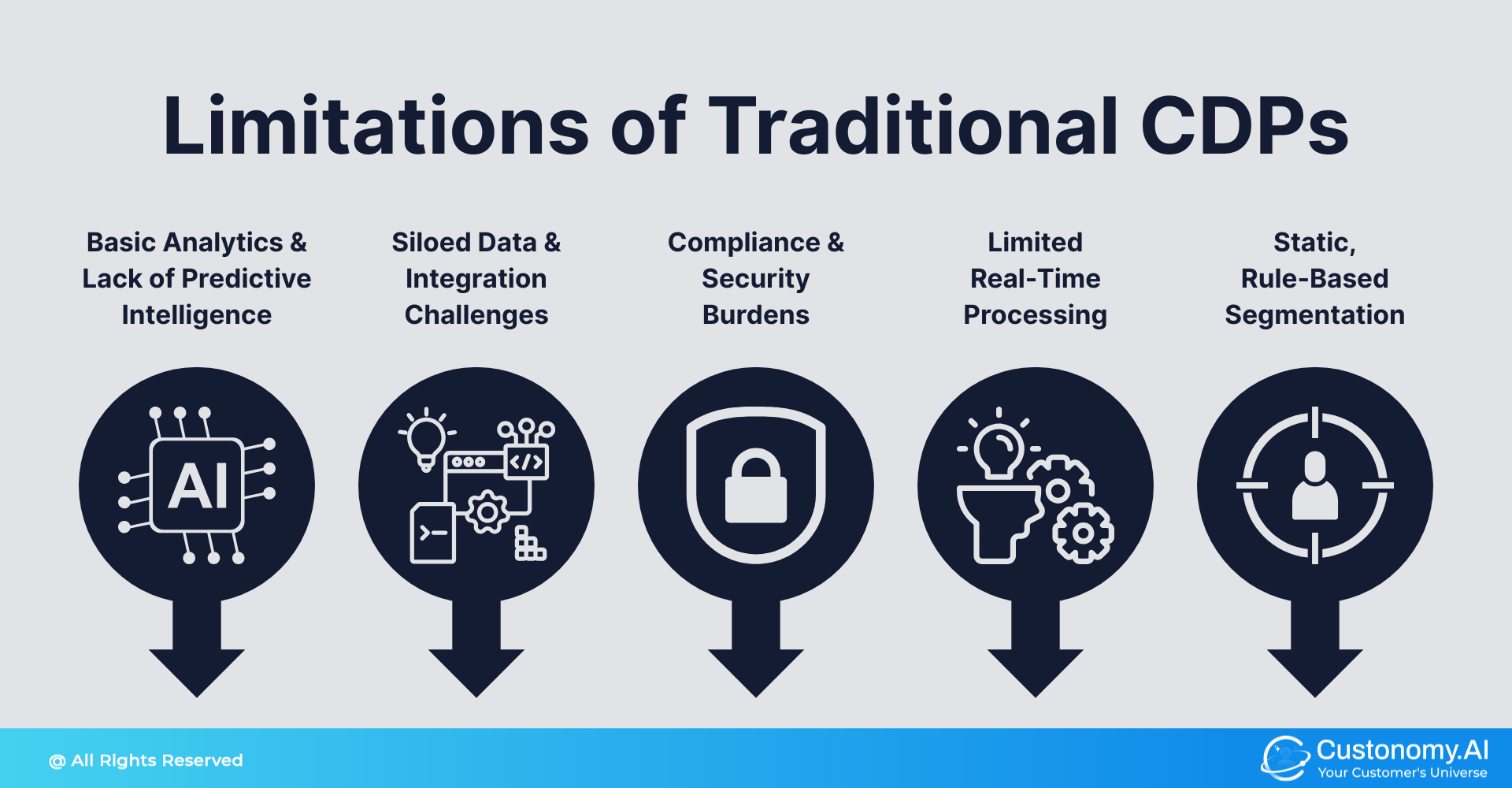
Traditional Customer Data Platforms (CDPs) have attempted to address these challenges, but their rule-based, static approach limits their ability to deliver truly personalized and data-driven customer experiences. This is where AI-Native CDPs are revolutionizing the game.
Unlike traditional CDPs, AI-native platforms don’t just collect and store customer data they analyze, predict, and act on it dynamically using advanced machine learning models. These AI-powered systems adapt to real-time behavior, uncover hidden revenue opportunities, and automate hyper-personalized marketing at scale.
CDPs were introduced to help businesses centralize customer data and create unified profiles for personalized marketing. While they have improved data management compared to legacy systems, traditional CDPs still come with significant limitations that hinder modern marketing efforts.
Traditional CDPs provide descriptive analytics—what happened in the past—but lack predictive and prescriptive analytics. Without AI-driven insights:
Many CDPs struggle to integrate seamlessly with all business systems, including CRM, eCommerce platforms, and third-party data sources. This results in:
With increasing data privacy regulations like GDPR and CCPA, businesses must ensure compliance when handling customer data. Traditional CDPs often require manual compliance processes, which:
Most traditional CDPs operate in batch mode, meaning customer data updates occur periodically rather than in real time. This delay creates several challenges:
Traditional CDPs rely on predefined rules to segment customers. These rule-based systems fail to adapt dynamically to customer behavior changes, leading to outdated and rigid customer profiles.
As a result:
As customer expectations for personalization and seamless experiences grow, businesses relying on traditional CDPs will fall behind. Marketers need a solution that processes data in real time, leverages AI for intelligence, and automates personalization at scale which is where AI-Native CDPs come in.
As businesses grapple with evolving customer expectations and massive data volumes, AI-Native CDPs have emerged as the next-generation solution. Unlike traditional CDPs that primarily store and organize customer data, AI-native CDPs go beyond data aggregation.

Unlock the Full Potential of your Customer Data with AI-driven Intelligence and Automation.
They analyze, predict, and act on customer behavior in real time using advanced machine learning models.
An AI-native CDP is not just a data repository, it is an intelligent system that continuously learns and adapts. Key characteristics include:
Advanced Data Governance & Security
AI-Driven Customer Intelligence
Hyper-Personalized Engagement at Scale
Real-Time Activation & Personalization
Traditional CDPs collect and store data, while AI-native CDPs analyze, predict, and act on data. This shift is crucial for businesses looking to improve marketing efficiency, boost sales, and enhance customer experience with data-driven, automated decision-making.
AI-native CDPs are more than just data repositories – they unlock actionable insights, optimize marketing performance, and drive revenue growth through automation and intelligence. Here’s how businesses benefit from adopting an AI-native CDP:
With increasing data privacy regulations like GDPR, CCPA, and industry-specific guidelines, businesses must ensure customer data is handled securely. AI-native CDPs simplify compliance by:
Example: An insurance company can automate consent tracking for customer data usage, ensuring compliance while delivering personalized policy recommendations.
Traditional marketing often misses key revenue opportunities. AI-native CDPs analyze customer behavior in real time, enabling businesses to:
Example: A retail brand using an AI-native CDP can instantly recognize when a customer is browsing high-value products and trigger a personalized discount to drive conversions.
Today’s consumers expect brands to know them and anticipate their needs. AI-native CDPs make hyper-personalization effortless with:
Example: A banking institution can tailor product recommendations (loans, credit cards, investment plans) based on a customer’s transaction history and spending behavior.
Deliver the Right Message to the Right Customer at the Right Moment with AI-Powered Personalization.
Every marketing dollar should count. AI-native CDPs optimize spend by ensuring precise targeting and reduced ad waste through:
Example: A CPG brand can use AI to segment customers based on purchase frequency and automatically trigger retargeting campaigns, improving customer retention rates.
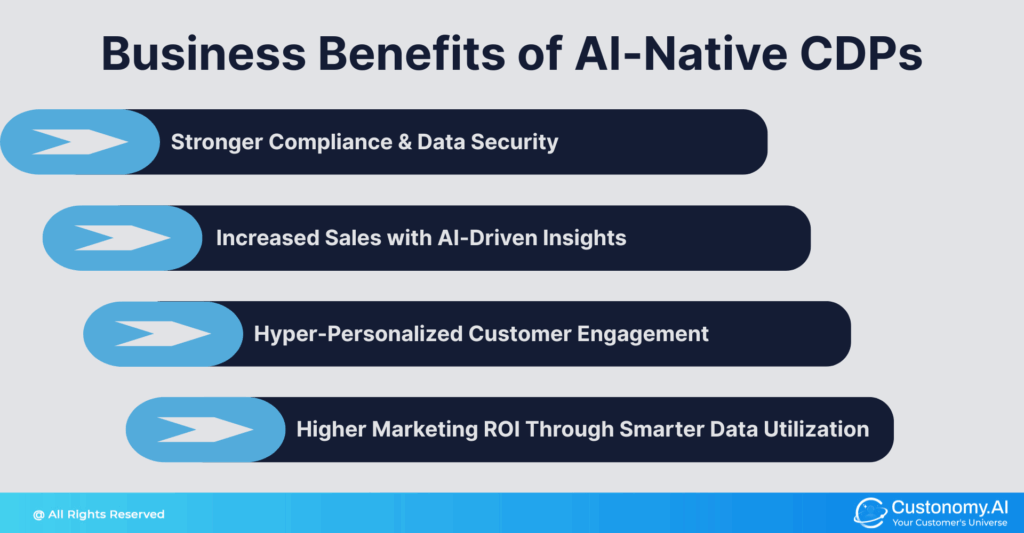
Businesses leveraging AI-native CDPs experience higher revenue, lower marketing costs, and stronger customer loyalty. By shifting from rule-based data management to intelligent, predictive customer engagement, companies can stay ahead of the competition and maximize their data’s value.
AI-native CDPs are transforming customer data management across various industries by enabling real-time intelligence, automation, and hyper-personalization. Here’s how different sectors leverage AI-powered customer intelligence for growth.
CPG companies often struggle with fragmented customer data across multiple retailers. AI-native CDPs solve this by:
AI-native CDPs empower insurance companies to deliver tailored policies and proactive customer engagement by:
Retailers and eCommerce brands thrive on personalized shopping experiences and timely engagement. AI-native CDPs empower them to:
Customers expect tailored financial solutions based on their transaction patterns and goals. AI-native CDPs help banks and financial institutions:
As customer expectations continue to evolve, businesses can no longer rely on traditional data management systems that fail to deliver real-time intelligence and personalization. Companies that embrace AI-driven customer intelligence will not only enhance customer engagement but also outperform competitors in revenue growth, efficiency, and long-term loyalty.
Now is the time to future-proof your customer data strategy – invest in an AI-native CDP and unlock the full potential of your customer insights.
Don’t Let Outdated Data Management Hold your Business Back. See how Custonomy can Transform your Customer Data Strategy.